
Product guide
IP65 vs IP67: Choosing Push-Button Ingress Protection
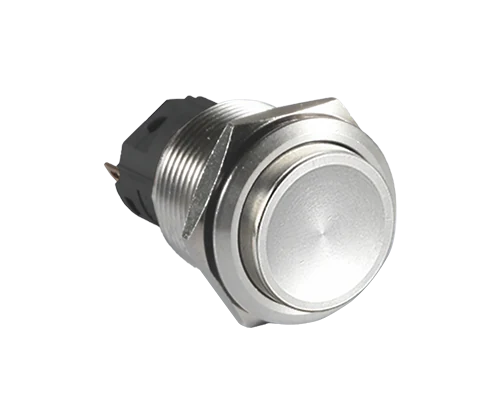
Compare IP65 jet protection with IP67 temporary-immersion protection, and check the sealing conditions of the installed push button.
In this article
IP65 and IP67 describe two different water tests, not two points on one scale. Choosing between them means deciding which test represents your installation — and remembering that the rating belongs to the assembled panel, not to the button alone.
Read the two digits separately.
The first digit covers solid bodies and dust; the second covers water. In both IP65 and IP67 the first digit is 6, which is the dust-tight classification. The difference is entirely in the second digit, and that digit refers to a specific test rather than to a general level of robustness.
IPX5 is a water jet test: water is projected at the enclosure from a nozzle from every practicable direction. IPX7 is a temporary immersion test: the enclosure is submerged under defined conditions of depth and time. They represent different events.
Understand why the ratings are not cumulative.
A device tested to IPX7 has not automatically passed IPX5. Immersion applies steady pressure over the whole surface; a jet applies a moving, concentrated force that can find a seal edge that immersion never loads. A product intended to satisfy both is tested for both and documented as such, usually written as IP65/IP67.
This is why reading a rating as "IP67 is higher, so it covers IP65" leads to the wrong part being fitted on a washdown line. Match the classification to the event you expect.
Match the rating to what actually happens at the panel.
Describe the real exposure before comparing datasheets. A machine cleaned with a hose faces jets. A control station in a wet area that may occasionally be flooded faces immersion. A panel in a dusty workshop may need the dust digit far more than either water test.
| Classification | Test represented | Typical situation |
|---|---|---|
| IP65 | Dust-tight; water jets from any direction | Hose cleaning, splash, outdoor exposure without submersion |
| IP67 | Dust-tight; temporary immersion | Panels that may be submerged briefly |
| IP65/IP67 | Both tests documented | Washdown areas where both events are credible |
Cleaning chemistry and temperature are not covered by an IP classification at all. Hot water and detergents act on seal materials over time, so record the cleaning regime alongside the rating you require.
Check the rating on the version you are ordering.
Within one family, protection often depends on the variant. Several current JINHONG metal push-button pages publish the front-face rating as IP65 with IP67 available on request, which means the higher classification is a version to order rather than a property of the family. Confirm it for the exact part number instead of inferring it from a sibling model.
| Family | Published protection |
|---|---|
| J16-M / J22-C metal push buttons | IP65; IP67 available on request |
| K16-G 22 mm push buttons | IP65 |
| F16 / M16 16 mm indicators | IP65 |
| K16 16 mm emergency stop | IP40; IP65 available on request |
Know what the classification does not cover.
An IP classification is a controlled laboratory test against solids and water. It says nothing about corrosion, about chemical attack on seals, about ultraviolet exposure, about vibration or about mechanical impact. Those are separate properties with separate evidence, and none of them can be inferred from a higher second digit.
Temperature is the most commonly missed of these. Seal materials stiffen when cold and soften when hot, and a cleaning cycle that alternates hot detergent with cold rinse works the seal harder than either would alone. Record the temperature range and the cleaning chemistry next to the rating you require.
Time is the other omission. A rating describes a product in its tested condition, not after two years of daily cleaning, repeated removal or a gasket that has taken a set. Where sealing is critical, treat it as something inspected during maintenance rather than a permanent property of the part.
Remember the rating describes the installed assembly.
A front-face rating assumes correct installation: the right cut-out, a clean sealing face, the specified gasket and the specified tightening. An oversized cut-out, a reused gasket or a panel that flexes will not deliver the documented classification however the part is labelled.
The rear of the device usually carries a different, lower rating, because it is expected to sit inside a protected enclosure. Where the panel itself is the barrier, the enclosure rating is the one that governs.
This split catches people out when a device is mounted on an external wall, a machine guard or a pendant rather than a sealed door. In those positions there is no enclosure behind the control to fall back on, so the rear of the device is exposed to the same environment as the front, and a front-face classification on its own no longer describes the installation.
Ingress protection checklist
These fields turn an assumption about sealing into something that can be specified and checked.
| Check | Information to record |
|---|---|
| Exposure | Jets, immersion, dust, or a combination, and how often. |
| Cleaning | Chemicals, temperature and pressure used. |
| Part number | The documented rating for the exact version ordered. |
| Installation | Cut-out tolerance, gasket, sealing face and tightening. |
| Enclosure | The rating of the panel behind the device. |
Is IP67 always the safer choice?
Not for jet exposure. If the panel is cleaned with a hose, the jet test is the relevant one, and a device documented only for immersion has not demonstrated it. Where both events are credible, specify a product documented for both.
Does a higher rating mean better corrosion resistance?
No. An IP classification covers solids and water ingress only. Corrosion resistance follows from the materials and finish, and salt or chemical exposure is specified separately.
Explore the products
Catalogue examples from the ranges discussed. Open a model to check its configuration and technical details.
Request model drawings and selection support