Product guide
How to Choose a 22mm Push Button Switch
Specify a 22mm push button using the mounting drawing, operating action, contact duty, illumination and enclosure requirements.
In this article
22 mm is the most common panel cut-out for industrial operator controls. That standard hole is where the similarity ends: within it sit bodies, contact arrangements, ratings and illumination options that behave very differently.
Confirm the cut-out and the depth behind it.
A 22 mm designation refers to the mounting hole, and it is what allows devices to be interchanged across a panel. It says nothing about how far the device projects behind that hole. Contact blocks, lamp modules and the stacking arrangement all add depth, and a crowded door is where a selection usually fails.
Record the panel thickness range as well. A device qualified for a thin sheet may not seal correctly on a heavier door, and the clamping arrangement differs between families.
Decide between a metal and a plastic body.
Metal bodies suit exposed positions and locations where the control may be struck. Plastic bodies are lighter, often less expensive and entirely appropriate inside a protected enclosure. The choice is about the mounting position and the handling it will receive, not about a general idea of quality.
Published ratings differ between the two, and the difference is worth reading carefully before deciding on appearance.
| Family | Body | Thermal current | Contact material | Protection |
|---|---|---|---|---|
| J22-C | Metal, high current | 20 A | Silver alloy | IP65; IP67 available on request |
| K16-G | Plastic | 5 A | Gold-plated silver alloy | IP65 |
| 22K16 emergency stop | Plastic | 5 A | Silver alloy, gold-plated | IP65 |
The contrast between 20 A and 5 A is not a quality ranking. A high-current family is built to switch load; a gold-plated contact is built to make a reliable connection at the low currents of a controller input. Choose against the circuit the button will sit in.
Specify the contact blocks, not just the head.
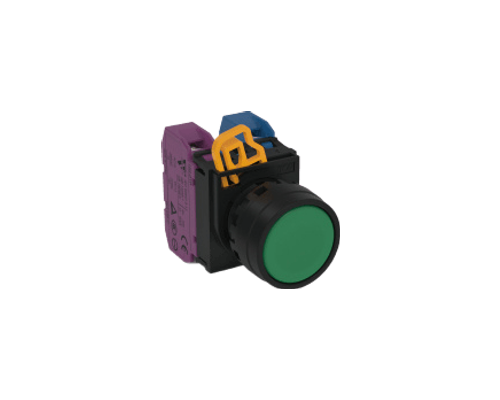
In most 22 mm systems the actuator and the contact blocks are separate decisions. Decide how many normally open and normally closed contacts the function needs, whether they mount directly or on a holder, and whether the assembly still clears the panel once they are fitted.
Keep the operating action explicit in the specification. Momentary and latching versions of the same head can look identical on a panel and behave completely differently in the circuit.
Treat illumination as a separate circuit.
An illuminated 22 mm button has a lamp supply independent of its contacts. Confirm the lamp voltage and whether it is AC or DC for the exact part number, and confirm how the lamp terminals are arranged before the panel is wired.
Decide what the lamp is reporting. Lighting on press confirms a command; reporting a machine condition requires the lamp to be driven by the controller. Both are legitimate, but the panel should be consistent about which convention it uses.
Standardise legends across the whole fleet.
A 22 mm panel is usually one of many in a building, and its value grows when every machine uses the same conventions. Agree the colour scheme, the legend wording and the physical order of start, stop and reset once, then apply it everywhere. Maintenance teams and operators moving between machines then read a new panel correctly on the first attempt.
Keep legend text short and literal. A legend describing the machine action is more useful than one describing the electrical function, because the operator is thinking about the machine, not the circuit.
Record the scheme somewhere durable. Panel conventions that live only in one engineer's memory drift within a couple of years, and the drift is usually discovered when two machines disagree about which colour means stop.
Check the environment for the version you order.
Within a 22 mm family, ingress protection often depends on the variant. Several current catalogue pages publish IP65 with IP67 available on request, which makes the higher rating something to order rather than something to assume. Operating temperature for the metal families above is published as −25 °C to +60 °C.
Published life figures for the 22 mm metal families are 300,000 mechanical and 100,000 electrical operations. Compare those against operations per shift and the planned service interval before committing.
22 mm specification checklist
Recording these fields keeps a mixed panel consistent and makes later replacement straightforward.
| Check | Information to record |
|---|---|
| Panel | Cut-out, panel thickness, rear depth available and spacing between devices. |
| Body | Metal or plastic, head style, legend and colour. |
| Action | Momentary or latching, stated explicitly. |
| Contacts | Number of NO and NC contacts, mounting method and switching load. |
| Illumination | Lamp voltage, AC or DC, and what the lamp reports. |
| Environment | Documented protection for the ordered version, plus temperature range. |
Are all 22 mm devices interchangeable?
They share the mounting hole, which is what makes a panel layout portable. Depth behind the panel, contact block systems, clamping and lamp arrangements are not standardised in the same way, so confirm fit and function rather than assuming the cut-out settles it.
Should I use the highest current rating available?
Not automatically. A 20 A family is built to switch load, while a gold-plated contact is built to make a reliable circuit at controller-input levels. Matching the contact to the circuit matters more than choosing the largest number.
Explore the products
Catalogue examples from the ranges discussed. Open a model to check its configuration and technical details.

J22-C Non-Illuminated Flat Head Metal Push Button Switch (Momentary)
View model