
Product guide
Metal Push Button Switches: Types and Selection Guide
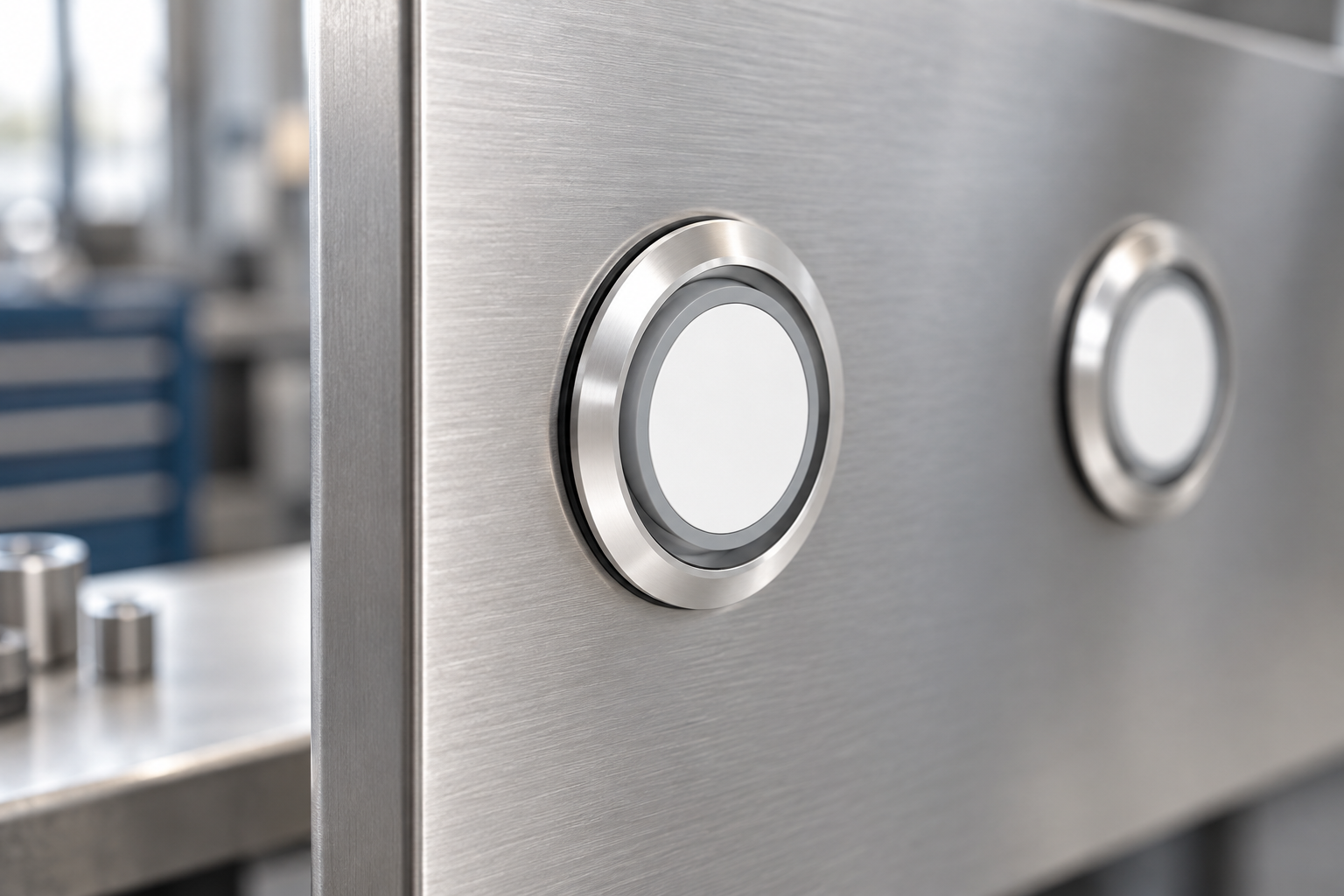
Compare metal push-button actions, head styles, mounting sizes and electrical ratings, then specify the right control for your panel.
In this article
A metal push button is a panel-mounted control with a metal actuator or housing. It sends a start, stop, reset or other command through an electrical contact. Its suitability for an application depends on the complete device and its installed assembly, not on the housing material alone.
Decide the action before anything else.
A momentary mechanism returns to its rest position when released. A latching mechanism retains its operated position until the next operation. This single decision changes the wiring, the machine logic and often the legend, so it belongs at the start of a selection rather than the end.
Contact descriptions always refer to the unoperated condition. A normally open contact closes on operation; a normally closed contact opens. What the command actually does is decided by the control circuit: a momentary start button can begin a machine function that continues long after the operator releases it, because the circuit latches, not the button.
Where an operator must be able to see the state of the machine rather than the state of their own last command, add a separate indicator. A button that lights when pressed confirms the press; it does not confirm that the machine responded.
Choose the head style and the panel cut-out.
Head style affects how easily a control is found by touch and how likely it is to be operated unintentionally. Flat heads sit close to the panel and resist accidental operation. Raised and domed heads are easier to find without looking. Mushroom heads are reserved for functions that must be struck quickly, and in most panel conventions that means stop functions only.
The mounting diameter is fixed by the cut-out, so it is a panel decision as much as an electrical one. Confirm the panel thickness range and the rear clearance before choosing, because a short body may be the only option behind a crowded door.
Read the load rating against the real circuit.
Thermal current is a continuous rating for the contact under defined conditions. It is not a statement about inrush, motor loads or switching a capacitive supply. Compare the documented rating with the actual circuit, including any surge the load produces when it is energised.
Ratings vary considerably across sizes. The published figures below are taken from current JINHONG catalogue pages and show why a family decision cannot be made from size alone.
| Family | Thermal current | Contact material | Protection |
|---|---|---|---|
| J16-M (16 mm) | 5 A | Gold-plated silver alloy | IP65; IP67 available on request |
| J22-C (22 mm, high current) | 20 A | Silver alloy | IP65; IP67 available on request |
| K16-G (22 mm, plastic body) | 5 A | Gold-plated silver alloy | IP65 |
Contact material matters at the other end of the range. Gold-plated contacts are intended to stay reliable at the low currents and voltages typical of a controller input, where an oxide film on a plain contact can prevent a clean signal. A high-current family optimised for load switching is not automatically the better choice for a signal-level circuit.
Confirm the environment the button will actually live in.
An ingress rating applies to a documented product tested under defined conditions. It describes the front face, the seal and the installed assembly together. A metal housing does not by itself raise the rating, and a correct button fitted into an oversized or unsealed cut-out does not deliver the rating printed on the datasheet.
Record the cleaning regime as well as the weather. Jetting, temperature and cleaning chemistry all act on the seal and the actuator, and they are the conditions most often left out of a specification. Operating temperature for the families above is published as −25 °C to +60 °C.
Check the life figures against the duty cycle.
Mechanical life describes the movement of the mechanism with no load. Electrical life describes operations while switching a defined load and is normally much lower. A station operated a few times per shift and a station operated every cycle of a fast machine are different problems even when the button is identical.
The 16 mm and 22 mm metal families above publish 300,000 mechanical operations and 100,000 electrical operations. Multiply the expected operations per shift by the planned service interval before deciding whether those figures are comfortable.
Metal push-button selection worksheet
Use the same fields when comparing models so that a difference in appearance does not hide a difference in electrical function.
| Check | Information to record |
|---|---|
| Mechanical | Panel cut-out, panel thickness, head style and rear clearance. |
| Electrical | Operating action, contact arrangement, switching load and any lamp supply. |
| Signal level | Whether the contact feeds a controller input or a load, and the contact material that suits it. |
| Environment | Documented ingress protection, temperature range and cleaning method. |
| Duty | Operations per shift, planned service interval and the published life figures. |
Does a metal housing automatically mean a higher ingress rating?
No. Protection depends on the documented product and the installed assembly, including its seals and the cut-out it is fitted into. Compare exact published ratings rather than inferring one from the housing material.
Can I use a high-current button for a low-level signal?
Check the minimum switching capability and the contact material rather than assuming the larger rating is safer. Contacts intended for load switching may not reliably make a circuit at controller-input levels; a gold-plated contact is normally specified for that duty.
Explore the products
Catalogue examples from the ranges discussed. Open a model to check its configuration and technical details.

J16-M Non-Illuminated Flat Head Metal Push Button Switch (Momentary)
View model