
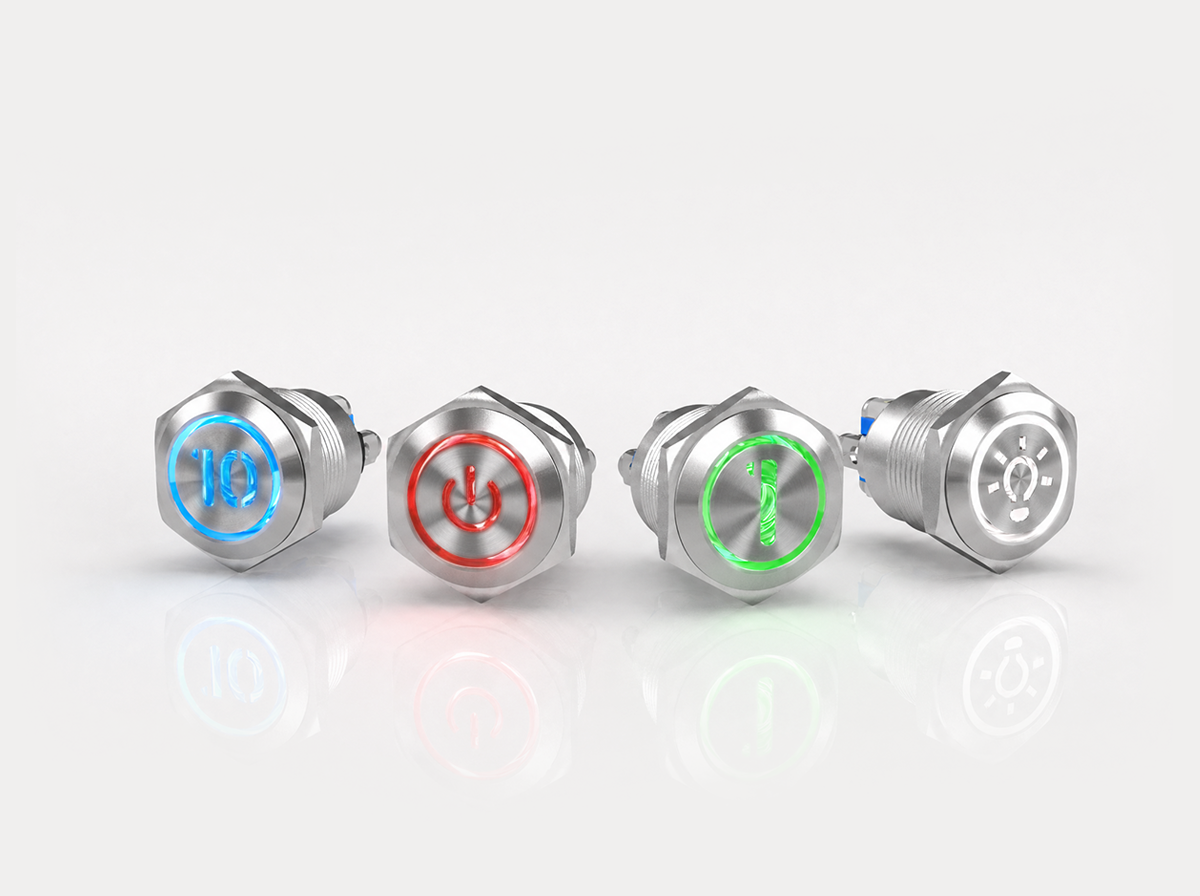
JINHONG supplies metal push-button switches for industrial control panels and OEM equipment. The actuator is the part operators touch and the environment reaches first. For dry, protected panels, 304 can be a sound choice; for coastal air, outdoor exposure or frequent cleaning, we specify a 316 actuator where the order calls for greater resistance to chloride-related corrosion. This article explains that decision—and the rest of the switch specification that must be checked alongside it.
In this article
- Key Takeaways
- 304 and 316 Stainless Steel: What Is the Difference?
- 304 vs 316 at a Glance
- Why the Actuator Material Matters
- Better Resistance to Pitting
- Better Performance in Crevices
- More Confidence Outdoors and Near the Coast
- A More Robust Choice for Frequent Cleaning
- Does 316 Make the Entire Switch Better?
- When evaluating a metal push button, check the complete specification:
- When Is 304 Still the Right Choice?
- Why We Choose 316 for the Button Actuator
- Common Misconceptions
- A Practical Selection Checklist
- Frequently Asked Questions
- Can 304 be used outdoors?
- Can buyers tell 304 and 316 apart by appearance?
- Is 316 enough for every marine application?
- Conclusion: Specify the Actuator for the Site
Key Takeaways
- 304 is a capable general-purpose stainless steel, offering good appearance, formability, and corrosion resistance in many indoor environments.
- 316 adds molybdenum, typically about 2–3%, which improves resistance to localized pitting and crevice corrosion where chlorides are present.
- 316 is not “rust-proof,” and material alone does not determine reliability. Sealing, machining, surface finish, contacts, installation, and verified test data still matter.
- Our material decision is conditional: specify 316 for the exposed actuator when chloride or repeated wet cleaning raises corrosion risk; use 304 where exposure is mild and cost matters.
304 and 316 Stainless Steel: What Is the Difference?
Both 304 and 316 are austenitic stainless steels. Their chromium content supports the formation of a thin passive oxide layer that helps the surface resist corrosion. 304 is widely used because it combines good corrosion resistance, manufacturability, and cost.
The key difference is that 316 contains molybdenum and usually a somewhat higher nickel content. Molybdenum strengthens resistance to localized attack when the passive layer is challenged by salt, chloride-containing moisture, or aggressive cleaning residues. In practice, this is why 316 is commonly considered for marine, coastal, food-processing, pharmaceutical, and chemical-adjacent applications.
Material background: worldstainless design guidelines describe 316’s molybdenum addition and stronger chloride-related corrosion resistance. Actual service performance still depends on exposure, fabrication and maintenance.
304 vs 316 at a Glance
Start with the operating environment, not appearance. The table is a selection guide, not a guarantee for every chemical or installation.
| Selection factor | 304 stainless steel | 316 stainless steel |
|---|---|---|
| Alloy | Chromium–nickel austenitic grade | Chromium–nickel grade with roughly 2–3% molybdenum |
| Chloride exposure | Good in mild, low-chloride service | Greater resistance to localized pitting and crevice corrosion |
| Typical panel setting | Dry indoor equipment with controlled cleaning | Humid, coastal, outdoor or frequently cleaned equipment |
| Purchase versus service cost | Lower initial material cost | Higher initial cost; potential maintenance margin in harsh service |
Both grades can look nearly identical. For a project that requires 316, request traceable material documentation rather than judging by finish.
Why the Actuator Material Matters
The button head sits at the boundary between the operator and the equipment. It is repeatedly touched, sometimes scratched, and often surrounded by moisture, dust, sweat, detergents, or airborne salts. Deposits can collect around the bezel and other tight gaps, creating conditions where crevice corrosion can start.
A coastal access panel and a dry indoor cabinet may use the same button shape, yet face different deposits and cleaning routines. Small pits or corrosion around close-fitting parts can make an exposed control harder to clean and inspect. Specify the actuator alloy for the actual site, then check drainage, sealing and installation separately.
1. Better Resistance to Pitting
Chlorides can break down the passive layer at small points and create pits. The molybdenum in 316 improves resistance to this localized mechanism. This matters because a button can remain visually clean over most of its surface while small aggressive sites develop around deposits or scratches.
2. Better Performance in Crevices
Moisture can remain around a bezel, label plate, or sealing interface after the open surface appears dry. These oxygen-depleted gaps are more demanding than a broad, freely washed surface. 316 offers a useful advantage, although good drainage and correct sealing remain essential.
3. More Confidence Outdoors and Near the Coast
Marine aerosols do not stay at the shoreline. Wind-borne salt can reach outdoor kiosks, access-control panels, cranes, charging equipment, and machinery located many kilometres inland. Road salt and industrial chloride contamination can create similar exposure. In such locations, the added material cost can be small compared with a service visit or premature replacement.

4. A More Robust Choice for Frequent Cleaning
Food, beverage, and hygiene-sensitive equipment may be wiped or washed repeatedly. The exact result depends on cleaner chemistry, concentration, temperature, contact time, and rinsing. 316 is not immune to every chemical, but it generally provides a wider corrosion-resistance margin than 304 for many wet-cleaning environments.
Does 316 Make the Entire Switch Better?
Not by itself. The actuator grade is only one part of a reliable push-button assembly. A 316 button head cannot compensate for an unsuitable gasket, poor panel-hole preparation, incorrect tightening, water retained behind the panel, or contacts used outside their rated load.
When evaluating a metal push button, check the complete specification:
- Which exposed parts are actually 316—only the actuator, or also the bezel and nut?
- What stainless grade is stated on the drawing, bill of materials, or material certificate?
- What ingress-protection rating applies after correct panel installation?
- Which gasket material is used, and is it compatible with the temperature and cleaning chemicals?
- What are the contact rating, electrical life, mechanical life, and switching-load limitations?
- How should panel-hole dimensions, panel thickness, and tightening torque be controlled?
When Is 304 Still the Right Choice?
304 remains a practical choice for dry indoor cabinets, protected machinery and mild cleaning with limited salt exposure. Specifying 316 everywhere adds cost without necessarily adding value; define the site and the consequence of corrosion before choosing a grade.
Why We Choose 316 for the Button Actuator
We choose 316 for the exposed button actuator when chloride deposits, humidity or frequent wash-down make localized corrosion the key material risk. For an OEM selling one panel design into both a dry factory and a coastal site, the coastal installation is the reason to check the more resistant actuator grade.
Consider a frequently cleaned food-equipment panel: rinse water may clear the visible button face while residue remains in the narrow actuator–bezel gap. That localized exposure is a concrete reason to specify the more corrosion-resistant actuator. It is a design example, not a claim about a measured JINHONG field result; sealing and cleaning procedures must still be checked.

In the product data for J22-271 Ring Light Flat Metal Pushbutton, the material entry distinguishes a SUS304 housing from a SUS316 actuator. A “316 button” therefore does not mean every metal part is 316.
The entry also lists IP65 protection (IP67 available on request) and a configurable 1NO+1NC contact form. IP performance depends on the sealed design and correct panel installation; the contact form depends on the ordered electrical configuration. Neither follows from the actuator alloy. Before specifying this model for a wash-down or coastal panel, confirm the exact variant, exposed bezel and nut materials, gasket and electrical load.
Common Misconceptions
- “316 never corrodes.” False. High chloride concentration, elevated temperature, stagnant deposits, strong chemicals, fabrication contamination, and poor maintenance can still cause corrosion.
- “A magnet test proves the grade.” False. Cold working can change magnetic response, and a simple magnet cannot reliably distinguish 304 from 316. Use traceable material documentation or appropriate material analysis.
- “316 automatically means a higher IP rating.” False. IP performance depends on the complete sealed design and installation, not the alloy grade alone.
- “316 is selected mainly because it is stronger.” Usually false for this application. The main reason is corrosion resistance; mechanical properties depend on condition and product design.
A Practical Selection Checklist
- Define exposure: Indoor or outdoor, distance from the coast, humidity, salt, cleaning agent, temperature, and wash frequency.
- Assess consequences: Is discoloration acceptable? How costly are access, downtime, or field replacement?
- Verify scope: Confirm exactly which external parts are 316 and request traceable evidence when the project requires it.
- Check the system: Match sealing, contact rating, illumination voltage, terminal style, and panel installation to the application.
- Maintain correctly: Prevent iron contamination during fabrication, rinse harmful deposits, and inspect exposed controls at suitable intervals.

Frequently Asked Questions
Can 304 be used outdoors?
Yes, in many mild outdoor environments. Exposure severity, shelter, rainfall, pollution, and maintenance all influence the result. Coastal or salt-contaminated sites generally favour 316.
Can buyers tell 304 and 316 apart by appearance?
No. They can look virtually identical. For critical projects, confirm the grade through supplier documentation, positive material identification, or an agreed inspection method.
Is 316 enough for every marine application?
No. Severe splash zones, permanent salt deposits, immersion, or high temperature may require more resistant alloys or protective design measures. Describe the actual environment to the manufacturer before selection.
Conclusion: Specify the Actuator for the Site
For chloride-prone or repeatedly cleaned panels, we specify a 316 actuator because its molybdenum addition improves resistance to pitting and crevice corrosion at the exposed touch point. The ordered material scope, sealing and electrical ratings still need confirmation.
Share the panel drawing, operating voltage, load type, installation location, cleaning method, expected quantity and required documentation with our team. We can help judge whether 304 or 316 is the better actuator grade for the site, then confirm the available switch configuration, sealing arrangement and electrical specification. Send your enquiry through our contact form.