
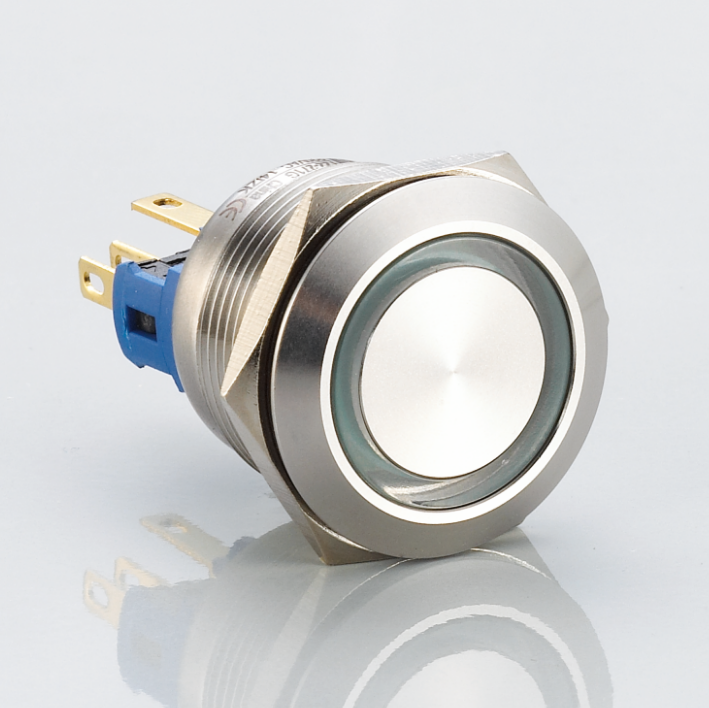
Two push buttons can look almost identical from the outside. They may have the same metal housing, LED ring, actuator shape, and mounting size. Turn them over—or examine the contact assembly—and an important difference can appear.
On specified JINHONG switches, the electrical contacts and copper terminal pins are gold-plated. Some alternative designs use silver alloys, tin, nickel, bare copper, or another surface system instead. Why add cost and manufacturing steps to parts that many customers will never see? Because the long-term stability of a switch is often decided at those hidden electrical interfaces.

The Real Reason We Use Gold
Gold plating is not used because gold has the highest bulk conductivity. At room temperature, representative values for high-purity metals are approximately 63 MS/m for silver, 59.6 MS/m for copper, and 41 MS/m for gold. Silver and copper conduct better in bulk.
The reason is the surface. Gold resists oxidation and ordinary atmospheric corrosion, helping the small areas where two conductors meet remain electrically stable. Copper can carry current efficiently beneath the plating, while the gold surface protects the interface exposed to air, humidity, storage, and handling.
Reliability starts where you can’t see it.
A switch contact is an interface problem, not only a bulk-conductivity problem. This distinction explains why a thin engineered surface can matter even when the conductor underneath is already highly conductive.
Why Doesn’t Every Switch Use Gold-Plated Contacts?
Gold plating adds material cost, surface-treatment steps, process control, and inspection requirements. It is also unnecessary for every load. A contact system intended for higher switching energy may use a silver-based material, while a connector may use tin, nickel, or another finish selected for its mating system and environment.
Manufacturers therefore make different tradeoffs according to target price, load type, expected environment, product positioning, and service requirements. An unplated or non-gold contact is not automatically poor quality; it may be the correct engineering choice for its application.
JINHONG makes a deliberate choice on specified models: we invest more in the contact interface when oxidation resistance and low-energy signal stability justify it. The part is small and mostly hidden, but its function is central to electrical continuity.
What Happens at the Contact Surface?
Two apparently smooth contacts do not touch across their full visible area. Current passes through microscopic high points. Contact force, surface films, contamination, wear, and oxidation determine how reliably those small conducting spots carry a signal.
Bare copper can form oxide films in air. In a higher-energy circuit, voltage, current, wiping action, or arcing may disrupt a film. A PLC input, sensor circuit, or other low-current signal may have too little electrical or mechanical energy to do so consistently. At that point, surface condition can matter more than the small difference between the bulk conductivity of the metals.

Try it: what the surface condition changes
Two contacts never touch across their whole visible face. Current crosses at a few microscopic high points — which is why the condition of that surface can matter more than the metal underneath it.
Swipe the diagram sideways to see all of it.
Clean plated interface. Current crosses at the contact spots and the signal is steady.
Illustration of the mechanism described above, not a measurement. Plating does not raise a current rating or an IP rating; confirm the plated parts, base material, contact form and load rating for the model you select.
Four Advantages of Gold Plating in Our Switches
- More stable contact resistance. Gold does not readily form the insulating oxide layers associated with many base metals. For PLC inputs, sensors, instrumentation, and low-energy control circuits, this helps reduce the risk of intermittent or unstable signals caused by changes at the contact surface.
- Better resistance to oxidation and atmospheric corrosion. Humidity, oxygen, industrial pollutants, and storage time can alter an exposed metal surface. A gold-plated interface gives equipment builders more margin where the switch must remain ready in ordinary industrial environments.
- More dependable operation after long idle periods. Alarm circuits, maintenance controls, spare equipment, and emergency functions may sit unused for months. Gold plating helps preserve the contact surface during that idle time, so the first operation is less dependent on breaking through an oxide film.
- A protected copper terminal interface. Copper provides an efficient current path; gold helps protect the exposed connection surface during storage, transport, assembly, and service. This supports a more consistent interface for a compatible connector or soldering process.
Why Gold-Plate the Copper Terminals Too?
Copper terminals are not gold-plated because copper is a poor conductor. Copper is excellent for carrying current. The concern is what happens at the exposed surface: bare copper can discolor and oxidize while a switch is stored, transported, installed, or used.
Gold plating protects the area that meets a connector, wire, or solder joint. It is a functional surface treatment, not a cosmetic upgrade. The complete connection still depends on compatible materials, correct soldering or crimping, adequate connector fit, strain relief, cleanliness, and use within the specified electrical rating.

Gold-Plated vs Unplated: What Actually Changes?
| Factor | Gold-plated interface on specified JINHONG models | Unplated or other surface system |
|---|---|---|
| Initial conductivity | Good | Can also be good |
| Oxidation resistance | Higher at the plated functional surface | Depends on the base material and finish |
| Low-current signal stability | Particularly useful where surface films can affect a weak signal | More dependent on surface condition and the selected contact system |
| Long idle periods | Helps preserve a stable contact interface | Surface films may have greater influence, depending on material and environment |
| Manufacturing process | Requires an additional controlled plating process | May be simpler, depending on the chosen material system |
| Manufacturing cost | Higher because of material and processing | Often lower, although the complete design determines cost |
This comparison does not divide switches into “good” and “bad.” It shows why two externally similar products can have different internal costs, design priorities, and suitability for a particular circuit.
Where Gold Plating Helps Most
- Low-voltage or low-current signal switching.
- PLC inputs, sensors, instrumentation, and control circuits.
- Controls that may remain unused for long periods.
- Equipment exposed to humidity or ordinary atmospheric contamination.
- Compact contacts where a small surface film can influence continuity.
- Terminal interfaces that need protection during storage, assembly, and service.
For high-current, inductive, lamp, motor, or other loads that create significant arcing, a different contact material or engineered system may be more suitable. The load type and verified switch rating must guide selection.
Gold Plating Isn’t Magic
- It does not by itself increase the rated current or switching capacity.
- It does not create a higher IP rating; sealing and correct panel installation determine ingress protection.
- It does not make a contact immune to wear, contamination, excessive heat, fretting, or electrical overstress.
- It cannot compensate for insufficient contact force, unsuitable geometry, a loose terminal, or an incompatible connector.
- It may be damaged by substantial arc energy, so power-switching applications require the correct complete contact system.
For a controlled project, confirm which parts are plated, the base material, the applicable plating specification, terminal type, contact form, load rating, environmental limits, and required documentation for the selected model.
What We Pay Attention to Inside a JINHONG Switch
| Easy to see from outside | Less visible but electrically important |
|---|---|
| Metal housing and surface finish | Contact material and contact geometry |
| LED ring and colour | Contact surface treatment |
| Button shape and symbol | Copper terminal finish |
| Mounting size | Contact force and internal structure |
Customers naturally begin with the features they can see. We also pay attention to the hidden electrical interfaces that determine whether a low-energy signal can pass consistently. On specified models, gold plating is one part of that design decision—not a decorative claim and not a substitute for complete switch engineering.
Products to Explore
Examples from the metal push button range include the J12 Illuminated Power Mark Metal Pushbutton, the J16-E Illuminated Power Mark Metal Pushbutton, and the J22-271 Ring Light Flat Metal Pushbutton. These links help compare mounting sizes and configurations; do not assume every variant uses the same contact or terminal finish. Confirm the exact plating specification, contact material, terminal option, load rating, and sealing requirement for the model you intend to order.
Frequently Asked Questions
Why are switch contacts gold-plated?
Gold provides an oxidation-resistant functional surface. In low-energy circuits, that can help contact resistance remain more stable when a weak signal cannot reliably break through an oxide film.
Is gold more conductive than copper?
No. Copper has higher bulk conductivity. Gold is selected at the contact surface mainly because it resists oxidation and helps preserve a stable interface.
Why are copper terminals gold-plated?
The copper carries current efficiently, while the gold protects the exposed connection surface from oxidation and discoloration during storage and service.
Are gold-plated contacts better for low-current signals?
They can be particularly advantageous because surface films have a greater effect when switching energy is low. The correct choice still depends on the signal, environment, contact design, and specified model.
Does gold plating increase a switch’s current rating?
No. Current rating depends on the complete contact system, conductor cross-section, geometry, contact force, temperature rise, arc behaviour, and verified test conditions.
Conclusion: The Difference Is in the Interface
We do not use gold plating simply to make a component look premium. On specified JINHONG switches, it protects critical electrical interfaces where oxidation and surface condition can affect long-term connection stability. Copper carries current efficiently; the gold surface helps keep the point of contact dependable.
That is the value of a design detail most customers never see: additional material and manufacturing work applied where a signal actually passes. Reliability starts where you can’t see it.
Share the model, circuit voltage, current, load type, switching frequency, environment, terminal method, expected quantity, and required documentation with our team. We can confirm whether a gold-plated contact system is appropriate and identify the available configuration. Send your enquiry through our contact form.