
Product guide
How Electromechanical Relays Work: Coil and Contacts
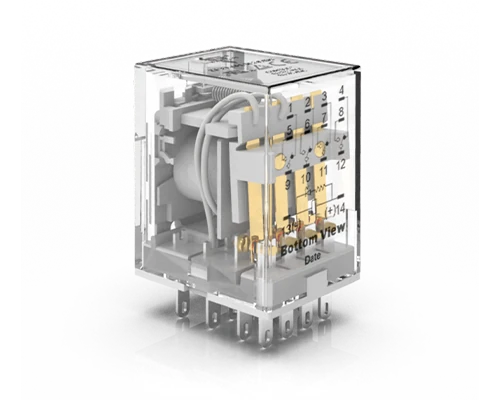
Understand relay coils, NO/NC contacts and socket matching, with practical checks for load ratings, suppression and installation.
In this article
An electromechanical relay uses an electromagnetic coil to move contacts. This lets a control circuit operate a separate load circuit within the relay’s documented electrical limits.
What changes when the coil is energised?
In a typical non-latching relay, coil current creates a magnetic field that moves an armature. Normally open contacts close and normally closed contacts open. When the coil is de-energised, the return mechanism restores the unoperated state. Latching relays work differently, so check the model description.
| Part | What to check |
|---|---|
| Coil | Rated voltage, AC/DC type, operating range and power demand |
| Contacts | NO/NC arrangement, poles and load-specific switching ratings |
| Insulation | Documented separation and ratings for the circuits involved |
| Socket | Compatible terminal layout, mounting and connection method |
Common types of electromechanical relay.
Electromechanical relays are usually grouped by how they mount and what they are built to switch. The groups below match the Jinhong relay range; check the individual model for its exact ratings.
| Relay type | Typical use | Jinhong series |
|---|---|---|
| General-purpose plug-in relay | Control panels where the relay plugs into a DIN-rail socket and can be replaced quickly | ZJ10F (octal base), ZJ18F |
| PCB power relay | Equipment boards that switch heavier loads, soldered to the PCB or fitted to a socket where offered | ZJ14F, ZJ115F |
| Slim interface relay | Interfacing PLC outputs to field devices where panel width is limited | ZJ157F, ZJ41F |
| Force-guided relay | Circuits that need mechanically linked contacts for monitoring; a component, not a complete safety module | ZJA4, ZJA6 |
Relays can also be non-latching (the usual type, which returns to rest when the coil is de-energised) or latching (which holds its last position). A solid-state relay is a different device: it has no moving contacts, but it has an on-state voltage drop and off-state leakage current that a mechanical contact does not.
Do not select on current alone.
A resistive-load rating does not automatically apply to a motor, solenoid or capacitive input. Review inrush, switching frequency and electrical endurance. Low-level signals also need suitable contact characteristics. The relay and its socket both impose limits on the assembly.
Coil accessories and replacement.
Suppression components can reduce switching transients, but must suit the coil supply. A diode introduces polarity requirements and can affect release time. Verify the accessory and the required switching behaviour rather than adding a component by appearance.
A socket allows a compatible plug-in relay to be replaced without disturbing each field wire. Isolate the circuit before replacement and check the complete part number, pin layout and retaining arrangement.
Browse relays and relay sockets. A force-guided relay is a component with special contact characteristics; it should not be confused with a complete monitored safety relay module.
Relay assembly information to specify
Keep coil requirements separate from contact-load requirements. Include the socket in the same selection record when the relay is a plug-in type.
| Check | Information to record |
|---|---|
| Coil circuit | Nominal supply, AC/DC designation and applicable accessory requirements. |
| Contact circuit | Load type, voltage, current and required contact arrangement. |
| Installed assembly | Relay-to-socket compatibility, retention and installation environment. |
Does the coil voltage describe the load the contacts can switch?
No. Coil and contact ratings describe different parts of the relay. Check both against their respective circuits and verify the socket as part of the assembly.
Explore the products
Catalogue examples from the ranges discussed. Open a model to check its configuration and technical details.
Request model drawings and selection support